You can feel perfectly well at home.
Then you think about the train journey, the motorway, the meeting you cannot easily leave or the queue with no obvious toilet nearby, and your stomach or bladder suddenly feels urgent.
You check before you leave. You go once, then again just in case. You stop drinking before a journey, avoid eating until you arrive and choose the seat nearest the door. The moment a toilet becomes available, the urgency can ease before you have even used it.
Toilet anxiety develops when access to a toilet becomes connected with safety. A journey, queue or meeting predicts that access may be difficult. You monitor your body, notice sensations more quickly and interpret them as the beginning of an emergency. The anxiety can then intensify genuine gut or bladder sensations, making the prediction feel confirmed.
This does not mean the symptoms are imaginary, and it does not mean every bowel or urinary symptom is caused by anxiety. Physical symptoms need appropriate medical assessment. The anxiety pattern concerns what happens when urgency, access, escape and fear of losing control have become linked.
I am Louise Squires, a Clinical Hypnotherapist and Psychotherapist specialising in anxiety, panic, phobias and automatic patterns. I work online with clients throughout the UK and in person from Cavendish Square in London’s Harley Street medical district.
What does toilet anxiety look like?
The difficulty is not always how often you genuinely need the toilet. It can be the amount of planning required to feel safe enough to go somewhere.
- Checking toilet locations before accepting an invitation
- Going several times before leaving home
- Feeling an urge as soon as you put on your coat
- Planning motorway stops before the journey begins
- Avoiding routes with traffic or long stretches between services
- Choosing aisle seats, doors and exits
- Driving separately so you can leave when you need to
- Feeling worse when somebody else is driving
- Avoiding food before travelling
- Restricting drinks before meetings, flights or events
- Monitoring every movement in your stomach or bladder
- Leaving queues when urgency rises
- Turning down work that involves travel
- Feeling unable to concentrate in a meeting until you can leave
- Carrying spare clothes or medication as reassurance
- Feeling immediate relief when you see a toilet sign
Other people may see careful planning. They do not see how much of the day is being arranged around the possibility that your body may become urgent at the wrong time.
Which part of toilet anxiety is controlling your choices?
Toilet anxiety does not look exactly the same for everybody. The common thread is that your choices begin to depend on access, escape and what you believe your body might do next.
For you, the main problem may be leaving home. You can feel settled all morning, then notice urgency as soon as you put on your coat, collect your keys or hear that the taxi has arrived.
It may be journeys. You are less concerned about where you are going than the periods when you could not immediately stop, get off or reach a toilet.
It may be the fear of an accident. A sensation does not simply mean that you might need the toilet. It creates an immediate picture of not making it, somebody noticing, having to explain yourself or being unable to leave discreetly.
It may be situations that temporarily remove your freedom to get up. A meeting begins, the dentist lowers the chair, the hairdresser applies colour or somebody joins the queue behind you. Your bowel or bladder suddenly feels much more urgent because leaving now would be visible or disruptive.
Or you may need the toilet but find that you cannot go when you feel observed, overheard or rushed. This is the different pattern commonly described as shy bladder or paruresis.
Start with the situation that feels most familiar
- Why am I fine at home but need the toilet when I go out?
- Why does anxiety make me need the toilet?
- Why do I need to wee more when I’m anxious?
- Why do I need to know where the nearest toilet is?
- Why does traffic make me feel like I need the toilet?
- Why do queues make me feel like I need the toilet?
- Why do I suddenly need the toilet in meetings at work?
- Why do I go to the toilet three times before leaving home?
- Why do I stop eating or drinking before a journey?
- Why can’t I wee in public toilets?
Why does toilet anxiety get worse on trains and planes? This guide looks specifically at uncertain onboard toilet access, train doors closing, the seatbelt sign, queues, privacy and the moment control of the journey passes to a driver, timetable, train operator or cabin crew.
Why am I fine at home but need the toilet when I go out?
At home, the toilet is available. You do not need to predict what your body will do because you already know what you could do if a sensation appeared.
Away from home, the question changes. Will there be a toilet? Will it be open? Will the train stop? Could you leave the meeting without everybody noticing? What if traffic does not move?
Your mind begins checking the body for an answer. Normal movement, pressure or fullness now matters because it might develop into something you cannot manage. Attention amplifies the sensation, fear increases the physical response and the lack of an easy exit makes it feel more urgent.
Home has become associated with access and control. Going out has become associated with uncertainty.
Why does anxiety make me need the toilet?
Anxiety can affect both the digestive and urinary systems. A threat response changes muscle tension, breathing, attention and the activity of the gut. Some people notice looser stools, cramps or an urgent need to open their bowels. Others notice bladder pressure, repeated urges or the feeling that they have not emptied completely.
Anxiety also changes how you interpret sensations. A small signal that would pass unnoticed at home can feel important on a motorway because there is no immediate toilet. You check again, and the repeated checking makes the signal harder to ignore.
The sensation is real. The question is whether your response is proportionate to a current physical need or organised around the predicted consequence of not having immediate access.
Why do I need to wee more when I’m anxious?
A mild bladder sensation can become urgent before a journey, meeting, appointment or queue, even when you have just been. This guide explains repeated “just in case” visits, bladder monitoring and why feeling unable to leave changes the signal.
Why does knowing where the toilet is make me feel better?
The location provides an escape route. If this is the part you recognise most strongly, read why you may need to know where the nearest toilet is, including the sudden urgency that can appear in queues, meetings, dental and hair appointments, or as train doors close.
You may not need to use it. Simply knowing that you could reduces the predicted loss of control. Your body settles, which appears to prove that the toilet made you safe.
The relief is understandable. It can also teach your mind that access must be confirmed before you can relax. Next time, you check sooner and feel less able to enter somewhere without knowing the arrangements.
Why do I keep going before I leave home?
You go because you genuinely need to. Then you go again because the journey is approaching. The second visit produces a little urine or no bowel movement, but it gives temporary reassurance.
A few minutes later you check again. “What if I did not empty properly?” “What if the urge returns as soon as we reach traffic?”
Each visit is an attempt to create certainty about what your body will do later. Bodies do not offer that guarantee. Repeated trips can therefore become part of the leaving routine, and being unable to complete the routine can make the journey feel unsafe.
Why do traffic, queues and meetings make urgency worse?
These situations share one important feature: you cannot leave immediately without a consequence.
In traffic, the next exit may be miles away. In a queue, leaving means losing your place. In a meeting, standing up may attract attention. On a train, you cannot control when it stops. The predicted difficulty of leaving makes the body signal more important. Read why joining a queue can suddenly trigger bowel or bladder urgency.
You may think, “I’m fine until I know I can’t get out.” That is the overlap with feeling trapped and needing an escape route. Toilet anxiety gives the trapped feeling a particular feared outcome: an urgent bowel or bladder need, leakage or an accident in public.
Why does traffic make my stomach feel like an emergency?
You see brake lights and immediately calculate how long it would take to reach a toilet. The thought produces tension and gut activity. You check your stomach, find a sensation and decide the emergency has started.
You may move into the left lane, open the map, look for services or consider the hard shoulder. Those actions can reduce fear for a moment. They also keep attention fixed on the possibility that you may need to escape. Read why traffic and motorways can make you feel as though you urgently need the toilet.
If journeys have become organised around this prediction, the Travel Anxiety page explains the wider pattern of anticipatory anxiety, distance from safety and reliance on protective arrangements.
Why do I avoid food or restrict drinks before travelling?
Eating and drinking are treated as variables you can remove.
You skip breakfast before a train, stop drinking water in the afternoon before the theatre or avoid coffee on any day that includes a meeting. The immediate result may feel reassuring because you believe there will be less for your body to process.
The longer-term message is that ordinary food or fluid intake makes leaving unsafe. Restriction can also create thirst, dehydration, hunger, dizziness or bowel changes, which introduce more sensations to monitor.
Do not make significant changes to food or fluid intake without appropriate medical advice, particularly when you have a diagnosed bowel, bladder or other health condition.
Is bowel urgency anxiety the same as IBS?
No. Irritable bowel syndrome is a recognised digestive condition that can include abdominal pain or cramps, bloating, diarrhoea and constipation. The NHS advises seeing a GP if you think you may have IBS and have had symptoms for more than four weeks. Read the NHS guidance on IBS symptoms.
Some people have diagnosed IBS and also become anxious about urgency, access and accidents. Others have anxiety-related bowel sensations without an IBS diagnosis. A person may also have a separate gastrointestinal condition that requires medical care.
Hypnotherapy for the anxiety pattern does not replace diagnosis, investigation or treatment of digestive symptoms. It may be relevant when fear, monitoring, avoidance and safety behaviours are amplifying the impact of symptoms or continuing after appropriate assessment.
What about bladder urgency or fear of leakage?
Bladder urgency can be organised around the same access-and-control pattern. You use the toilet before leaving, then feel another urge at the station. You stop drinking before a journey and select every seat according to how easily you could get out.
Urinary frequency, urgency and leakage can have physical causes and deserve appropriate medical assessment. The NHS advises speaking to a GP about any type of urinary incontinence. Read the NHS urinary incontinence guidance.
Seek prompt medical advice for pain or burning when urinating, blood in the urine, fever, back pain, new difficulty passing urine or other concerning symptoms. The NHS provides current information about urinary tract infections.
Once medical needs have been addressed, the remaining anxiety may still involve constantly testing the bladder, going “just in case” and treating uncertain access as dangerous.
What if I need to wee but cannot go when somebody is nearby?
This is a different bladder-anxiety pattern. You may feel a genuine need to urinate, then find that nothing happens when somebody enters the toilet, waits outside the cubicle or stands at the next urinal.
Known as shy bladder or paruresis, the difficulty can appear when you feel observed, overheard, rushed or insufficiently private. You may urinate normally at home and struggle only in public toilets, at work, while travelling or when asked to provide a medical sample.
The more deliberately you try to make the flow begin, the more pressure you create around a process that normally happens automatically. Read more about shy bladder and why you may be unable to wee when other people are nearby.
Fear of having a bowel or bladder accident in public
The feared outcome may be much more than physical discomfort.
You imagine not reaching the toilet, losing control in front of people, the smell, a visible mark or having to leave without anybody understanding why. You may picture the exact moment it happens before there is any evidence that it will.
The fear can affect what you wear, what you carry and where you are prepared to go.
You choose dark clothes. You avoid white seats. You take spare underwear, wipes, pads, tissues or medication. You check whether a jacket could be tied around your waist. You choose the end seat so you can leave without asking anybody to move.
These arrangements may make an outing feel possible. They can also keep the predicted accident at the centre of the outing. Your mind credits the precautions for keeping you safe, so leaving without them feels increasingly risky.
Sometimes the fear began after a genuine episode of leakage, diarrhoea, illness or not reaching a toilet in time. That experience should not be dismissed. The difficulty develops when one event becomes the expected ending to every future journey, meeting, queue or unfamiliar place.
The aim is not to pretend that accidents are impossible or to ignore a diagnosed continence problem. It is to respond to what your body is actually doing without living as though public humiliation is about to happen every time immediate access is uncertain.
New, persistent, changing or unexplained leakage, bowel urgency or urinary symptoms should be medically assessed. Hypnotherapy does not diagnose or treat the physical cause of incontinence.
Read more about why the fear of having a bowel or bladder accident in public can become so convincing, including the clothing, checking and emergency preparations that can quietly keep it active.
Why logical reassurance does not always stop the urge
You may know where every service station is. You may have completed the journey many times without an accident. You may have been medically reassured.
The automatic response can continue because safety has been credited to your precautions. The journey went well because you did not eat. The meeting was manageable because you sat near the door. You stayed dry because you visited the toilet three times.
Your mind does not receive clear evidence that you could respond differently because the protective behaviour is treated as the reason nothing happened.
What I notice in my clinical work
In my clinical work, I notice that people often describe a striking difference between what happens at home and what happens when leaving would be difficult.
“I need to go three times before I leave.”
“Traffic makes my stomach feel like an emergency.”
“I stop drinking before journeys.”
“I can cope as long as I know there’s a toilet nearby.”
The location is not producing a different body. It is changing the predicted consequence of a sensation. When access feels easy, the signal can remain ordinary. When access feels uncertain, the same signal can become the beginning of a feared emergency.
How planning around toilets can make your life smaller
The restriction often develops gradually.
You turn down one journey because the traffic will be bad. You meet at the same familiar café because you know exactly where the toilet is. You drive separately so you can leave. You book an aisle seat. You avoid breakfast before travelling. You stop drinking before an appointment. You choose the shortest queue, the nearest exit and the route with the most service stations.
Each decision makes sense on its own. Together, they can begin deciding where you work, how you travel, which invitations you accept and how far you are willing to move from home.
You may still appear to be doing plenty. Other people see you at work, in the shop or on the journey. They do not see the checking, restriction, route research and repeated toilet visits required to get you there.
The question is not whether planning is always wrong. Practical planning is important when you have a diagnosed condition or a genuine need.
The question is whether the plan serves the day you want to have, or whether the entire day now serves the plan.
What changes when toilet access stops deciding what you can do?
You can still use a toilet when you need one. You can still plan sensibly for a diagnosed condition. The difference is that every journey no longer begins with an attempt to control your body completely.
- Leave home without repeating a just-in-case routine
- Drink according to your needs rather than the route
- Eat before travelling when you are hungry
- Choose a seat for comfort or conversation
- Remain in a queue without checking every sensation
- Travel while somebody else drives
- Attend meetings without supervising the nearest exit
- Notice a sensation without immediately creating the ending
- Use a toilet because you need it, not to prove you will be safe later
- Respond appropriately if a genuine physical need arises
The aim is not to promise that you will never need a toilet unexpectedly. It is to stop living as though every period without immediate access is likely to end in loss of control.
How may hypnotherapy help with toilet anxiety?
Hypnotherapy may be used to work with the automatic association between uncertain access, body sensations, urgency, escape and fear.
We look at your individual sequence: where the fear appears, whether symptoms have been medically assessed, which sensations receive your attention, what you predict will happen, what you avoid, what provides temporary relief and how you want to respond instead.
The work is not about ignoring a genuine bowel or bladder need. It is about distinguishing what your body is actually asking for from the emergency your mind has learned to predict.
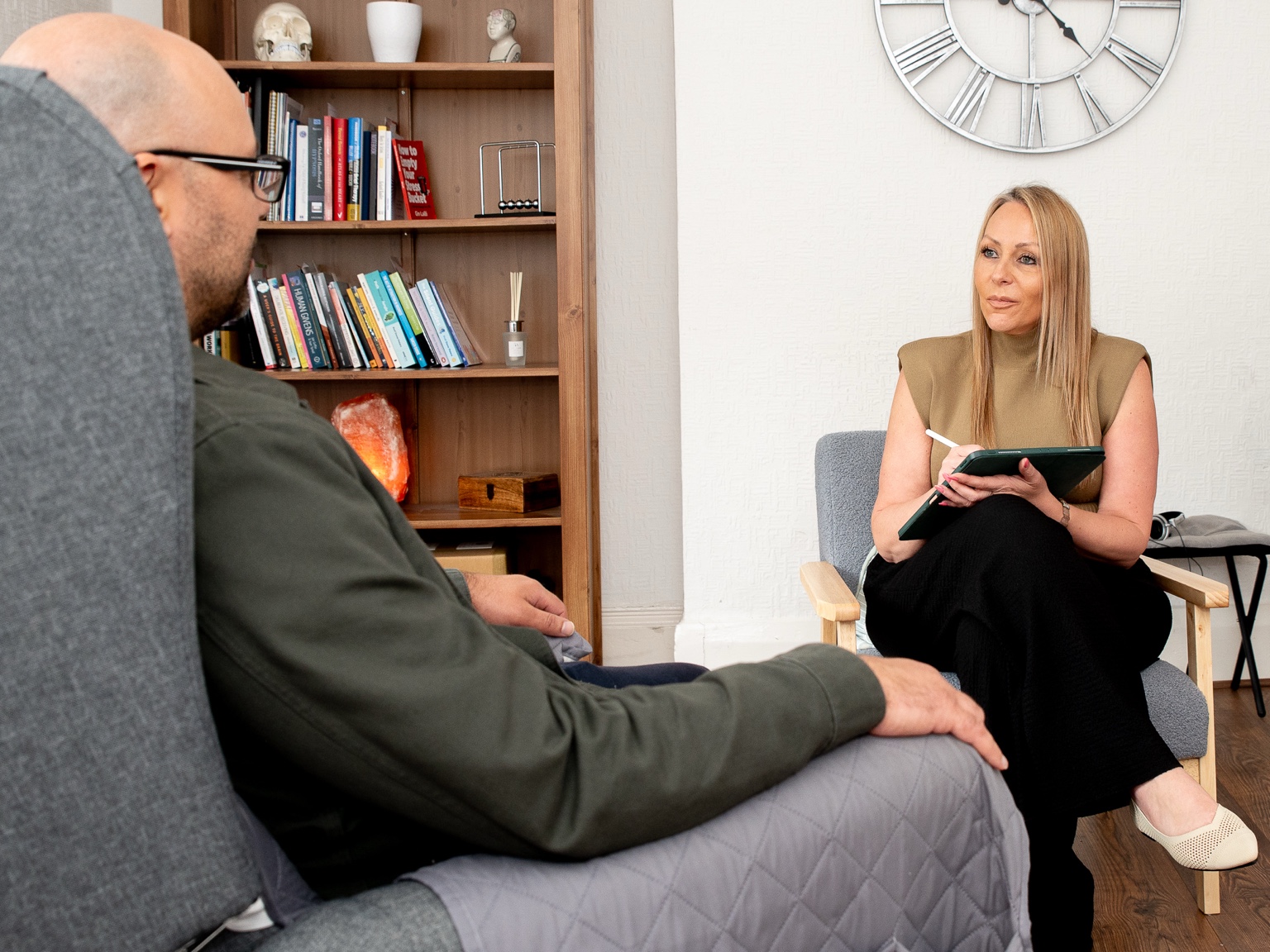
Focused work for people ready to move beyond the pattern
You may already understand why the urgency happens. You know that you often feel better when a toilet appears, the traffic moves, the meeting ends or the plan is cancelled. You may have explained the pattern to yourself many times.
Logical understanding does not always stop an automatic response.
My Focused Hypnotherapy Programme works with the individual sequence connecting the situation, the predicted consequence, the physical response and the behaviour that temporarily makes you feel safer.
The aim is not to teach you to ignore your body. It is to help an appropriate bowel or bladder signal remain a signal rather than automatically becoming a public emergency you must prevent.
Initial consultation
We discuss the situations that create urgency, what has been medically assessed and how checking, planning, restriction or escape currently maintain a sense of safety.
One to four structured sessions
The programme involves one to four structured sessions. Some clients find one or two sessions are all they need. I recommend the appropriate option after understanding the nature, history and impact of the pattern.
Supporting audio and ongoing support
Every client receives supporting audio and ongoing support from me as part of the programme.
Online throughout the UK and in Harley Street
Online appointments are available throughout the UK, so you can access specialist toilet-anxiety support without travelling to London. In-person appointments are available privately in Cavendish Square, within the Harley Street medical district.
Learn more about online hypnotherapy, my clinical experience and approach, the Harley Street clinic or the wider Anxiety Hub.
When should bowel or bladder symptoms be medically assessed?
New, unexplained, persistent, worsening or concerning bowel or urinary symptoms should be discussed with a GP or another appropriate medical professional. Seek urgent advice when symptoms are severe or accompanied by red-flag features such as blood, severe pain, fever, unexplained weight loss, inability to pass urine or signs of significant dehydration.
If you already have a diagnosed bowel or bladder condition, follow the advice of the clinicians responsible for your care. Hypnotherapy does not replace medical investigation or treatment.
Questions about toilet anxiety and urgency
Is toilet anxiety the same as IBS?
No. IBS is a recognised digestive condition and toilet anxiety describes fear organised around urgency, access, accidents or being unable to leave. They can occur separately or together. New, changing or unexplained bowel symptoms should be medically assessed.
Can anxiety make you feel as though you need the toilet?
Yes. Anxiety can affect the gut and bladder, increase attention to physical sensations and make ordinary signals feel urgent. Symptoms can also have medical causes, so persistent, new or concerning symptoms should be assessed appropriately.
Can hypnotherapy help with bowel and bladder urgency anxiety?
Hypnotherapy may help address the automatic link between a situation, body monitoring, predicted urgency, fear and protective behaviour. It does not replace medical assessment or treatment for bowel or urinary symptoms. Visit the general hypnotherapy FAQs for practical information.
Why do I feel better as soon as I know a toilet is nearby?
Knowing a toilet is available removes the predicted problem of being unable to act. Anxiety reduces, body monitoring becomes less intense and the sensation may settle before you use the toilet. That relief can also strengthen the belief that confirmed access is required before you can feel safe.
Can toilet anxiety happen when I have IBS or a bladder condition?
Yes. A genuine bowel or bladder condition and anxiety about urgency, access or accidents can exist together. Continue to follow medical advice for the condition. Hypnotherapy may be considered for the anxiety and automatic responses surrounding it, not as a replacement for diagnosis or medical treatment.
Why do I need the toilet when I know I cannot easily leave?
Situations such as meetings, queues, trains, dentists and hair appointments can make a mild sensation feel urgent because leaving now appears difficult, visible or disruptive. Attention moves towards the bowel or bladder, anxiety increases and the sensation becomes harder to ignore.
Go because you want to go, not because a toilet has granted permission
You do not need to organise every journey, meeting and meal around the question of whether your body might become urgent.
You can plan sensibly, respect genuine medical needs and still stop treating every uncertain stretch of time as an approaching accident.
Your initial consultation is where we identify how toilet access became connected with safety, clarify the response you want and decide whether my focused approach is appropriate for you.
Your consultation deposit is deducted from any sessions you subsequently book. The 48-hour cancellation policy applies.